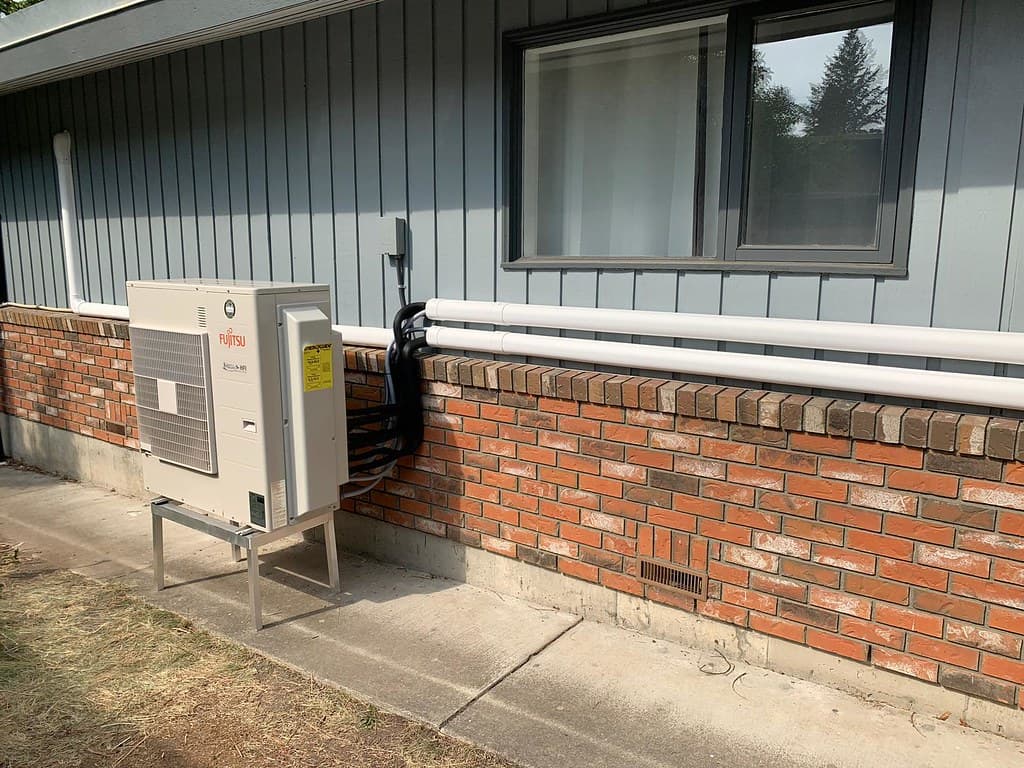
Here's the short answer before the scroll. On Staten Island, a single-zone mini-split (one outdoor unit, one indoor head, one room solved) usually runs $4,500–$6,500 installed. Two and three-zone systems land between $9,000 and $17,000. A whole-home system with four or five zones typically runs $14,000–$25,000 before Con Edison rebates. Brooklyn rowhouses and Manhattan co-ops trend toward the top of each range — sometimes past it — for reasons we'll walk through below.
These are the numbers we actually quote, not internet averages. We install Mitsubishi ductless systems every week across Staten Island, and every quote is written, with model numbers, after a load calculation — never a guess from the driveway.
The quick numbers
Every house is different, but after years of installs across the borough and over the bridges, the quotes cluster into predictable bands:
| Configuration | Typical installed price | Where we see it |
|---|---|---|
| Single-zone (1 room) | $4,500 – $6,500 | Finished attic, primary bedroom, garage conversion, one hot top-floor room |
| Two-zone | $9,000 – $13,000 | Top floor plus main living area in a semi-attached home |
| Three-zone | $12,000 – $17,000 | Cape cods and smaller colonials going mostly ductless |
| Whole-home (4–5 zones) | $14,000 – $25,000 | Colonials, rowhouses, and brownstone floor-throughs replacing window units for good |
Prices are before Con Edison NYS Clean Heat rebates. Quotes are free, written, and priced net of current rebate amounts.
What those numbers include
A real installed price should cover the whole job, not just the box. When we quote the ranges above, that means:
- Cold-climate Mitsubishi equipment — units that hold full rated heat at 5°F, not budget models that quit in January
- Labor by installers who do this weekly, including mounting, vacuum-and-charge, and commissioning
- Insulated line sets with line-hide covers routed so they don't scar your siding or facade
- A dedicated electrical circuit and outdoor disconnect
- NYC DOB permit filing where required
- Con Edison rebate filing and manufacturer warranty registration — paperwork we carry, not you
What actually moves the price
Two houses on the same block can get quotes thousands of dollars apart — legitimately. These are the levers:
- Zone count. The biggest lever by far. Each indoor head adds equipment, line set, and labor.
- Line-set length and routing. A condenser ten feet from the head is cheap to connect. Three floors of masonry chase down a rowhouse facade is not.
- Electrical capacity. Most homes just need a new circuit. Older homes still on 100-amp service sometimes need a subpanel — typically $1,500–$3,000 extra, and we flag it at quote time, never mid-job.
- Head style. Wall-mounted heads are the baseline. Ceiling cassettes and floor consoles add roughly $500–$1,000 per zone.
- Condenser placement. A ground pad behind a detached house is the cheapest. Wall brackets, flood-zone elevation (standard in Midland Beach and South Beach blocks), and roof placement each add cost.
- Coastal specs. Near the shore we include coated coils and stainless hardware as standard. Some quotes skip it — and the unit pays for that in year eight.
- Building paperwork. Brooklyn and Manhattan co-ops and condos add alteration agreements, insurance certificates, and board timelines (more below).
Staten Island detached homes vs. Brooklyn & Manhattan brownstones and co-ops
Staten Island is the easy case, and it's why our quotes here usually sit at the bottom of each band. Detached and semi-attached homes give us short line runs, a ground-level spot for the condenser, and clear access. A Westerleigh colonial or Great Kills high ranch is a clean, predictable install.
Brooklyn rowhouses and brownstones change the geometry. The condenser usually lives in the rear yard or on the roof, and line sets run down the rear facade — several stories of ladder or scaffold work, masonry penetrations through brick or brownstone, and careful routing so the streetscape side stays untouched. A five-zone brownstone with a roof condenser and long line runs can land in the high $20,000s, and that's an honest price, not padding.
Manhattan adds administration more than hardware. Co-op and condo installs mean an alteration agreement, certificates of insurance, sometimes an engineer's letter, and a board calendar that moves at its own pace. The equipment costs the same; the approvals and logistics are the premium. Most Manhattan jobs we do are one or two single-zone systems per apartment — which keeps them closer to the single-zone band than you might expect.
Why two quotes for the same house can be $6,000 apart
When a quote comes in dramatically under everyone else's, there's usually a reason you'll meet later. The common corners we see cut: no load calculation (the system is sized by guesswork), uninsulated or exposed line sets (condensation stains and efficiency loss), budget equipment that isn't cold-climate rated (fine in July, useless in January), no permit filed, and no warranty registration — which can quietly void the manufacturer coverage you thought you had.
Cheap installs are the most expensive kind. The second contractor — the one who fixes it — costs more than doing it once.
What a real written quote should include
Whoever you hire — us or anyone else — insist on all of this in writing:
- A load calculation for your actual rooms, not 'same as the neighbor's'
- Model numbers for every indoor and outdoor unit
- A zone map: which head, which room, what size
- Line-set routing and where the condenser sits
- Electrical scope, including whether your panel needs work
- Permit costs stated, not 'included somewhere'
- The rebate shown as a line item, with the net price you'll actually pay
- Warranty terms and who registers them
Rebates change the math — sometimes a lot
Everything above is the gross price. Con Edison's NYS Clean Heat program pays real rebates on cold-climate systems in all three boroughs we serve, and federal tax credits have applied to qualifying heat pumps in recent years. On whole-home conversions, the combined effect can take thousands off. The amounts change often enough that we confirm them at quote time rather than print them here — the full picture is in our rebates guide.
Jobs like yours, recently
Real scopes from recent installs — the neighborhood, the home, the system, and what it fixed. No names, no stars, just the work.
Westerleigh, Staten Island · 1930s detached colonial
4-zone Mitsubishi hyper-heat multi-split — one head on the open first floor, three bedroom heads upstairs; gas boiler kept as cold-snap backup
The problem: Three window units every May, radiators with no cooling at all, and a second floor that never dropped below 80°F on July nights.
What changed: Window units retired for good, each bedroom on its own thermostat, and the boiler now fires only on the coldest nights. Line sets run down the rear wall in painted line-hide — nothing visible from the street.
Midland Beach, Staten Island · flood-zone cape cod with a finished attic
Single-zone 12,000 BTU cold-climate mini-split; condenser on an elevated bracket above flood grade, coastal-coated coil and stainless hardware
The problem: A finished attic office no duct had ever reached — unusable after noon from June to September, and a block where salt air and the 2012 flood line rule the equipment choices.
What changed: The attic now holds its own temperature year-round, the condenser sits above the flood line on a wall bracket, and the coastal spec means the coil isn't on an eight-year corrosion clock.
Bay Ridge, Brooklyn · brick rowhouse
2-zone Mitsubishi multi-split for the top floor — two bedroom heads fed from a rear-yard condenser, line sets chased down the rear facade
The problem: A top floor under a flat black roof running 12–15 degrees hotter than the parlor level, in a house with plaster walls nobody wanted opened.
What changed: Both top-floor bedrooms hold their set temperature through heat waves. All penetrations came through the rear brick — no plaster was cut, and the street-facing facade is untouched.
Hudson Heights, Manhattan · pre-war co-op apartment
Single-zone ductless system with board-approved placement; condensate pumped to an approved drain line rather than dripped to the setback
The problem: Radiator heat with no cooling, a co-op board with a real alteration agreement, and a building engineer with opinions about where condensate goes.
What changed: We prepared the alteration package and insurance certificates the board required, placed the equipment per the building's rules, and the apartment got quiet cooling without a window unit blocking the fire escape.
Mini-Split Installation Cost Guide: quick answers
How much does a single-zone mini-split cost installed on Staten Island?
Usually $4,500–$6,500 installed, including the equipment, a dedicated electrical circuit, insulated line set with line-hide, permit filing, and rebate paperwork. One room, one day of work in most homes.
How much does a whole-home mini-split system cost in NYC?
Four-to-five-zone whole-home systems typically run $14,000–$25,000 before rebates. Staten Island detached homes sit toward the bottom of that range; Brooklyn brownstones with roof condensers and long line runs can reach the high $20,000s.
Why is my Brooklyn brownstone quote higher than my friend's Staten Island quote?
Geometry and masonry. A brownstone install usually means a rear-yard or roof condenser, line sets run down several stories of facade, brick penetrations, and ladder or scaffold time. Same equipment, more labor — legitimately.
Is a mini-split cheaper than central air?
If your home already has sound ductwork, central AC and a ducted system cost about the same. If it doesn't — most pre-war and many semi-attached homes — a mini-split wins decisively, because adding new ductwork means demolition, patching, and lost closet space before the first vent blows air.
Will I need an electrical upgrade?
Every system needs its own circuit, which is included in our quotes. Homes still on 100-amp service sometimes need a subpanel, typically $1,500–$3,000 more. We check your panel during the quote visit and put it in writing — no mid-job surprises.
Can I save money by buying the equipment myself?
We don't recommend it, and we're not just protecting margin: self-sourced units usually carry no valid warranty without a licensed installer's registration, and sizing mistakes are the most expensive error in this trade. The equipment is the smaller half of what you're paying for.